Why a Sleek Attire Jacket Costs What It Costs

A note from the person who quotes your jacket, processes your order, sends out your design, and makes it.
If you're reading this, there's a good chance you have a quote from Sleek Attire sitting next to a few others. That's smart. I'd do the same. A line jacket is an expensive gift. So I want to show you what goes into the number on my quote, and be honest about what I've gotten wrong along the way, because both are part of what you're paying for.
What you're paying for
Sleek Attire is two machines and about one and a half people. I run production. My wife helps with the front end part-time and checks every jacket before it leaves. There's no sales floor and no production line. The person quoting your jacket is the same person who'll clean up your artwork, coordinate the digitizing, hoop the jacket, and embroider it.
Nearly ten years of doing that shows up in small decisions. Take hooping. I still use manual tension hoops instead of magnetic ones. Magnetic hoops are newer and they have real advantages: they're fast, and they're gentler on garments like hoodies that can get hoop burn. But on a line jacket with a dense back design, I get more control and more tension from a manual hoop, and those dense designs come out cleaner. When it's hooped right, I can hear it when I tap the fabric. The same goes for backing, where I know what goes under which garment and why, and for color, where I know the thread you pick on a screen will read differently once it's on twill under real light. None of that shows up as a line on the invoice. All of it is in the price.
What goes into one jacket
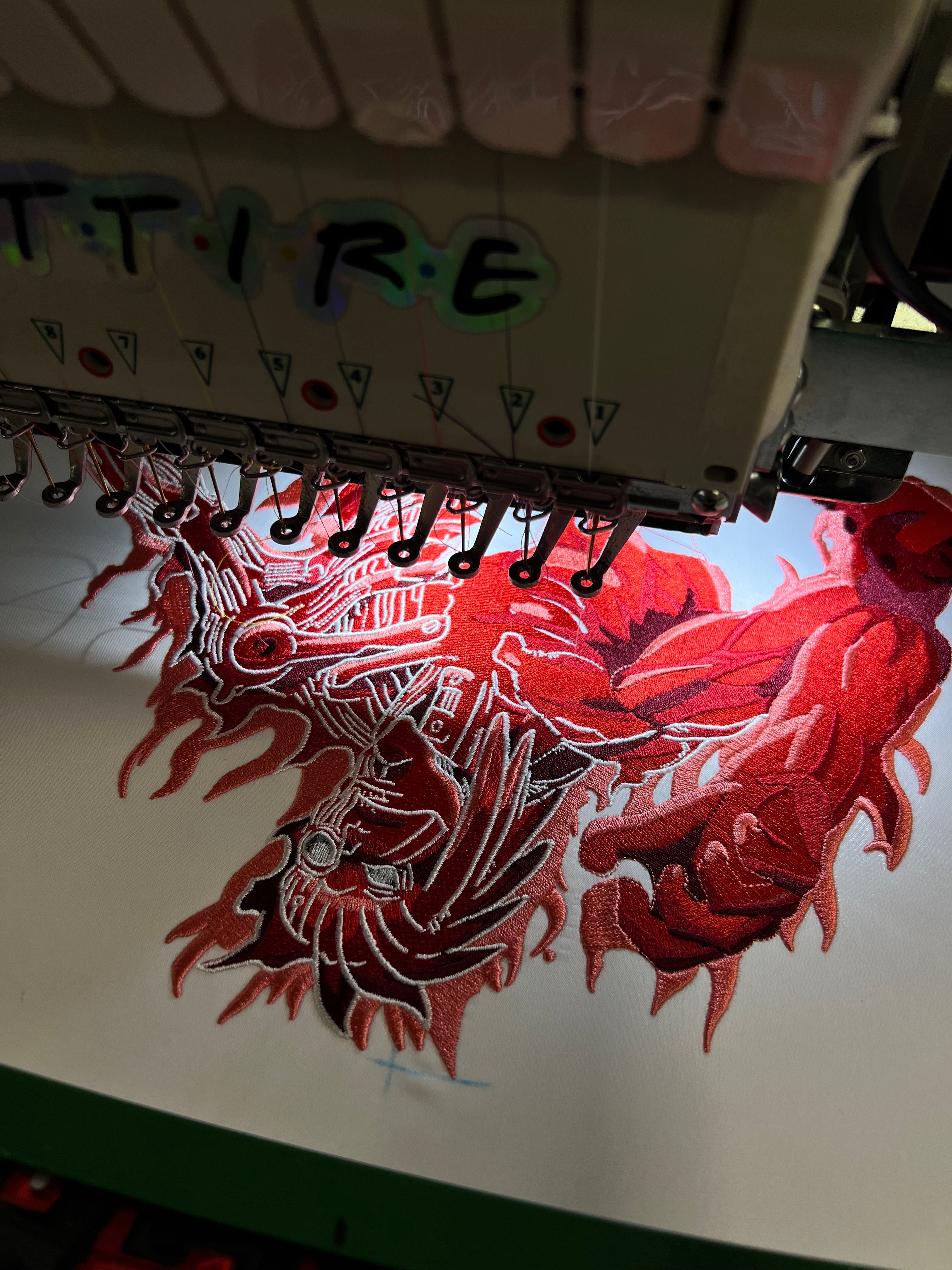
Most of the work happens before the machine ever starts. A detailed quote for a custom jacket can take me an hour or two by itself, because I'm working out the design, the placements, the colors, and what it will actually take to build. Then there's the artwork: my artist redraws and refines your idea around the focal points you asked for, and we go back and forth until it matches what you pictured.
Then the design goes to my digitizer, who turns it into a stitch file. A large design can take them close to a week. When the file comes back, it isn't done. I go through it, we tweak it, and it goes back and forth again until I'm confident it will actually work on the machine. Making a file and making it work in thread are two different jobs.
Meanwhile the twill letters get cut on a cutting machine, which runs through blades and adhesive faster than you'd think. Then comes setup: planning the color sequence and loading the machine can take a couple of hours on a complex design. Then the machine runs. Some jacket backs take six hours of machine time on their own. Then my wife checks it. That's one jacket.
What it takes to run a design
My machines hold 18 thread colors at a time. A typical 15-color design with around 200 color sequences takes me about two hours to set up and run.
A while back a customer brought us an album cover they wanted on a jacket. It had 28 colors and more than 400 sequences. The machine can't hold 28 colors, so I had to map out which colors were needed when, then swap spools in and out of the needles as the design ran. No spool stayed on the machine the whole time. Setup and running took me close to four hours, and I remember sitting with the stitch-out afterward because it was the best thing I'd made up to that point.
Nobody would have known if I'd reduced it to twelve colors. I would have.
That's also where the fun is. If you want a section in metallic gold, I can do that. If you want one element to stand out, I can do that with stitch direction and layering instead of another color. And sometimes I add something you didn't ask for. One client ordered a jacket as a gift for her little, whose name means star. Without telling her, I stitched her little's name, the symbol inside the number, and the small stars around the design in glow-in-the-dark thread. A fraternity brother ordered a Wukong design, and I did the Chinese characters at the bottom in glow thread too. He turned off the lights, and they lit up in front of him. Glow thread costs a lot more than most people would guess, even for a small spool. I use it anyway, because moments like that are part of what I'm making.
Why I haven't scaled up
I've talked with a lot of people about growing Sleek into a bigger operation, and every conversation comes back to the same trade-off. To scale, I'd need multi-head machines and large orders. My 15-color designs would likely have to become three or four flat colors, because that's what runs efficiently at volume. The price per piece on a big order would drop. But a single custom jacket would get more expensive, not less, because a one-off interrupts a production line.
I've chosen the other direction. I'd rather make complicated designs one at a time and put real hours into each one. That choice is why my quotes look the way they do, and it's why a one-of-one jacket from me doesn't cost what it would at a shop built for volume.
What I've gotten wrong, and what I changed
When I started, if a customer had feedback, I didn't know how to take it. I'd deflect. I'd explain why they were wrong. I always had something to say back. I'm not an outgoing person, and hearing criticism of something I'd made felt personal. It took me years to understand that there's truth in almost every piece of feedback, whether I want to hear it or not. People bring something up because it matters to them, and usually because they want the jacket to be right as much as I do. What I take from it is what counts.
One of the biggest changes came from my wife. She pointed out that I was the person making the jackets and also the person checking them, and that doesn't work. The person who makes something shouldn't be the only one who inspects it. She was right. There have been times I finished a jacket and completely missed a section, not because I didn't care but because I'd been staring at it for hours and couldn't see it anymore. Now she checks every jacket before it ships, so there's always a second set of eyes on it.
When something is my mistake now, I own it. I don't want a customer to have to argue with me or negotiate a compromise. If it's on me, I fix it. My name is on every jacket, and I'd rather fix a problem than defend it.
In close to ten years, I have a handful of customers who walked away unsatisfied. I think about them more than the ones who were happy, and every one of them changed something about how I work. This post is part of that too.
Comparing quotes
In the early years I had a competitive mindset. I was chasing money and watching what everyone else charged, and somewhere in there I lost my way. What I learned is that if you want to stay in this industry for the long haul, you have to decide what it's about. You can make it about money, or you can make it about something you're passionate about. I chose the second one, and I'm still here because of it.
A larger shop might quote you $200 for a jacket I'd quote at $300. That doesn't make them bad. Their equipment, order volume, and process are different from mine, and for a lot of people that's the right fit. At the other end, some of the larger Greek apparel brands can push a highly customized jacket into four figures once artwork and presentation packages are involved. I'm somewhere in between, and whatever I quote you, it'll be sick.
I'm not here to argue with anyone's budget. If you have $150 and my jacket is $500, I'm not going to talk you into $500, and I'll never push anyone toward a credit card for a jacket. What I make isn't the right fit for everyone, and that's okay. Whether you spend $100 with me or $1,000, the standard doesn't change. I don't have a cheap tier where I stop caring about the work.
If you already have a digitized file
More people are bringing their own files, sometimes from a friend who digitizes. You're welcome to send one. I'll look at it and tell you whether it will embroider the way you're picturing on the garment you've chosen. If it needs work, I'll explain what and why. The goal is the same either way: the right file on your jacket.
Why I still do this
I'm a veteran. Embroidery became the thing that settled me down after the Army, and it still is. When I'm stressed or tired, it's what quiets my head. So when I'm four hours into running your design at midnight, swapping spools and watching every color change, I'm not resenting it. That's the part I like.
Embroidery keeps changing, and I'm trying to change with it. I keep my mind open and keep taking on harder designs, because that's how I keep getting better. When I go to events, I see jackets I made years ago, and I can see how far the work has come since then. It keeps me humble.
I have one small dream I think about more than I'd admit. Someday I'll be traveling somewhere far from Tampa and spot a jacket I made in the distance. The person wearing it won't be a stranger. They'll be a past customer, and seeing them will feel like a distant memory coming back to me. I probably won't say anything. I'll just know.
That's what the price is for.
Start a Line Jacket Order →
See current pricing →
Michael Hsu is the founder of Sleek Attire, a Tampa custom embroidery studio specializing in original artwork, Greek line jackets, and detailed multi-color embroidery. He has worked in embroidery since 2017.